Blog

  • Who controls the NBN speed?

    Who controls the NBN speed?

    In an article in the West Australian newspaper by NBN CEO Bill Morrow, he talked of the three link chain that is the NBN and who controls the NBN speed?

    Because the NBN was scaled back to cut cost and to deliver a quicker completion we are stuck with some of the same problems that exist with the current ADSL-2 system.

    Namely, distance from the exchange a problem that has dogged many users for many years and slowed the speed of the NBN.

    One day somewhere in future time we will have high speed delivered right through to your computer. Then, who can we blame, perhaps the computer? More on that below.

    What we do get though are higher speeds than we have now and probably lower prices.

    Plus, a change in how we run our phone calls through the Internet.

    The three links in the chain that will affect your service are.

    1. How the NBN gets the signal to your home/ business and how good your internal wiring is.
      Now some will still be at the end of a long bit of copper coming from a local node. Some will have fibre and a few will have satellite access.
      You have no control over this, just ask the question at the start of the journey so you know what to expect.

    2 What speed you purchase from your carrier, 12, 25, 50 or 100 MBPS. You should, however, understand these are maximum speeds and not guaranteed in any way.
    You do have a say in this and can order a speed to suit your need. A majority of users are opting for the 25 MBPS plan which is probably three times greater than what you are getting now.

    The important bit is you have some level of choice provided you are in a reasonable access area.

    3 This is the important issue and again is partly in your control.  Certainly, you need to choose wisely.

    The carriers buy supply from the NBN and retail to you the customer.
    They buy in bulk in two quantum’s, one is an access fee the other is the collective amount of data that flows between the two networks at any point in time.
    If your carrier does not purchase enough data but adds excess customer they need to share the bandwidth thus reducing speed.
    This may be experienced at peak times. Just like the good old days.

    This experience is really exaggerated when on a Satellite link. Here they load the link with customers over a given area. Thus, performance deteriorates to a significant degree and there is no escape.

    Preparing for the experience.

    Who controls the NBN speed?

    How can you prepare for such an experience? Well the first principal is cheap is not always good and to ask your carrier what speeds you can expect during peak times.
    You may not get a good answer but at least you have a point of conjecture if it is not achieved.

    The NBN is now providing coverage for one in every two Australians so the roll-out is happening very quickly and will be complete in a couple of years to service over 12million premises.

    In an article  Sunday 30/07 Sunday times Western Australian. It was quoted that NBN was a Damaged brand. The report finished by saying that the NBN reported 23,700 Service class Zero locations unable to get the internet.
    Taken as a percentage of a completed service meeting 12 million premises equates to 0.002 percent in a country as big as Australia.

    Consider this; if NBN had gone for a first class roll out across Australia what damage would we see in delays and cost.

    A balanced view.

    For a balanced view listen to some of the good stories and look at issues other than the NBN.

    A friend of mine using a Telstra NBN service had terrible quality service.
    He moaned and groaned about the service with dropouts, slow service, and bad voice quality.
    Week after week I listen to the complaining until it was suggested he change his modem. The magic Fairy waved her wand and now he sings the virtues of fast internet and how good the NBN is.
    He blamed NBN, not his carrier and installer.
    Telstra should have advised correctly, on the equipment to be used.

    In conclusion, you should look at the three chains in the link and where problems may come from before joining the chorus of how bad things are and NBN bashing.

    I am not related to NBN in any way, I do have a proffered carrier but my opinion is based on realistic outcomes.
    I want faster internet and now I have a choice, that is a true step into the future.

    Peter Hanley

    Who controls the NBN speed?Who controls the NBN speed? You do.

  • do you have to go NBN

    do you have to go NBN

    Thinking about the internet, NBN and things that ring do you have to go NBN.

    It is a fact that we will all move to the NBN network sometime in the next three years.

    For some much sooner, you have about 18 months once it arrives in your area.

    I have had several conversations with industry people that have told me that the NBN won’t make it and we won’t need to change. They say there is no alternative to ISDN and that the coverage is just not there.Do you have to go NBN

    My Take on this is that NBN is a national company that is designed to replace the current copper network. It is halfway to the total implementation and a 2.5-year time frame to the finish.

    Furthermore, NBN only starts to make money when it has practical completion around 2020 when they expect to have around 8 million connections.

    Change or upgrade

    You can change PSTN, ISDN or any manner of lines to the NBN using your selected carrier by IP or SIP protocol.

    Yes, there will be a few areas that have limited access or slower speeds using the satellite as they fill the bandwidth channels and they will need to wait for a longer time.

    In a recent radio show, they were talking all things NBN and callers were ringing in and complaining.

    What amazed me was that nearly all were complaining about the current system and crying that it would not get better. Mostly from fringe areas where expectations are based on need not on reality.

    Yes NBN is more prone to dropouts than the current system as they work on it and make changes along the way but we all hope this improves.

    Back up system

    One option is to have a 4G automatic backup device that will fill in at any downtime. Yes, there is a cost but if phone calls are that important, and they are, this is a no-brainer.

    Data will be faster, the current average speed of a service using ADSL 2+ would be less than 8mbps upload.  Almost anything will be an improvement.

    In conclusion and in my prior reports, I emphasise that you should not wait until the last months to convert to NBN. It takes time and planning to get it right and to make the change.

    Ask us how at mail@verdi.net.au

    Peter Hanley

    Do you have to go NBN

  • Will Amazon destroy your business

    Will Amazon destroy your business, act now.

    If you are not yet alarmed, take a peek out from under your mushroom.

    In a recent look at this problem, will Amazon destroy your business, I thought about the many Amazon type businesses that are targeting your market.
    Amazon is not the only Elephant in the room. Every industry has a predator stalking your income, it happened to me it could also be you.

    Who is the enemy of your business?

    The enemy is Internet marketing and those that are using it properly are stealing away local business at an alarming rate.

    I had a comfortable first page ranking for many years.

    In a recent review was alarmed to see the number of paid pop up adds from my competitors, one glance at their site and I was stalked for months with enticing offers.

    Yes, when Amazon opens its doors in Australia there will be a rush to buy products from them but for years eBay and Gumtree have flown under the radar as low achievers.

    Ikea impacted on the sales of many businesses as did the recent introduction of Aldi to the market. While not in the category of Internet they are stealing your customers as I write.

    The medical and Dental industry should well be immune from attack but not quite so. The Health funds channel business to their preferred suppliers leaving the majority to cope on their own.

    In the latest Government report, online shopping represented an $18 billion industry and grew by 11% last year.

    Is your business impacted?

    Purchasing Tyres on line and auto parts provide low-cost options for many buyers keeping them away from your doors.

    Pharmaceuticals, Curtains, Furniture, books, electronics, Tools, Toys are all bought on line. Even entertainment is now mostly on line, no more the days of queuing in long lines.

    Is the food industry immune, I think not, online shopping is taking its toll on the local supply with the industry giants taking the share.

    I could go on with many more examples but have a think about your industry and where the trend is taking it.

    What can you do about it, or is it too late?

    Most of your business will be a local market and it is easy to find your dominant areas by tracking postcodes from your invoices.

    Many of us still like good old fashion service but even that is under attack from the Internet.
    On line business reviews can be great but they can also be debilitating to your effort when someone posts a bad review.

    Genuine complaints should be fixed before they go to press but there are professional complainers in the market that enjoy the personal destruction of your abilities.

    If you get a bad review make sure you get a balanced view from other satisfied clients to load the feature in your favor.

    Enter your local directories with either free or low-cost advertising to get at the top of search terms for your area.
    This will enhance your SEO and have you listed on page one in local searches.
    I recently searched a business and counted over a dozen different local directories.

    Keep in touch with your customer base using SMS or email marketing. It works! Ignore this at your peril. More on this here.

    Example Local fish and chip shop ( part of a group of three) posts a monthly special by email. I drive past my closest Fish shop which is empty to queue up with my voucher.

    Supply friendly service when they are in your doors, treat them like you need them. We all love having a mate in the business.

    Last of all, use a backup message service ( Verdi Messaging ) to make sure you never miss a phone call.

    You can make a difference to your result but don’t leave it until it is too late.

    It’s not too late but you have been warned.

    Peter Hanley 1800116116

    see also NBN updates

    will Amazon kill your business

  • SIP connections explained

    SIP connections explained

    VoIP, Voice over IP, SIP, SIP Trunk.

    First off all SIP Trunking is a relatively new technology that has a host of benefits for organisations.
    To gain a solid understanding of what it is, how it can benefit an organisation and what it’s benefits and drawbacks are, it’s important to understand how traditional phone systems work.
    This will aid in drawing comparisons between the two systems while giving context to the differences between them.

    A traditional phone system is quite simple. The paradigm has not changed much in the past hundred years. In theory, it’s possible to take an old landline phone from the 1960s, plug it into a phone line and make a call.

    A telephone handset is used to convert voice into analogue signals that are passed over a copper wire, to a gateway or exchange, through the public telephone network to the outside world.

    Traditional telephone systems depend on the original infrastructure, service providers and gateway equipment. In a large company, installing, operating and managing telephone infrastructure can be expensive and time-consuming.

    Hence using SIP trunking can reduce costs considerably by simply removing most of the components needed in a traditional telephone system. Therefore it’s much easier to install and upgrade, and provides more functionality than a traditional system. In addition, it  costs far less to make calls

    SIP connections explained

    SIP trunking is a protocol or communication standard that sends information over the internet, rather than over a fixed line telephone network.

    When comparing it to a traditional telephone line, it converts voice into a digital signal. Consequently, this is sent directly from the handset, over the internet to the outside world. It bypasses gateways and exchanges as well as the public telephone infrastructure.

    How does SIP trunking benefit a business?

    Cost reduction. In a traditional telephone system, ISDN and PSTN lines carry high monthly rental charges and high call costs. The cost of making a call to another country is usually very high. Using a SIP system, monthly rental charges are reduced and included value plans are more common. This gives business a known monthly cost for all of their rental and call costs.

    Scalability. With traditional ISDN and PSTN, scaling up was timely and expensive. Not only did you have to wait for more lines to be installed, but typically you had to purchase additional equipment for your PBX. With SIP, scaling up is as simple as making a phone call to your provider. Within minutes, you can have additional SIP lines added to your account.

    Reliability and ease of use. In modern cities, it is usually fairly easy to get a good quality, high bandwidth internet connection. Most companies also have redundant connectivity methods. This means that a SIP system has a high quality, redundant connection. In a traditional system, if the phone lines are damaged outside a building, all telephone communication is cut off.

    What are the drawbacks of a SIP system?

    Especially relevant is that a  SIP system depends entirely on the internet connection it uses.Furthermore, if a company uses a low bandwidth connection, voice quality and reliability can be negatively affected. In some instances, you may also need to purchase additional hardware to interface legacy PBX’s.

    In conclusion

    With the rollout of the Australian National Broadband Network, reliable connectivity will make SIP trunking a very real possibility for most companies.
    Reproduced from an article in June 2017 SIP connections explained by Greg Lipschitz MD at The Summit group.

    Peter Hanley
    fig-solutions.net
    SIP connections explained

  • NBN 101


    NBN 101 your guide to a better understanding.

    The nbn™ network is designed to give all Australians the opportunity to access fast and reliable internet services. How will it achieve this?

    Firstly the rollout of the nbn™ network promises to change the way we access the internet. Using a mix of technologies, the network is designed to provide every Australian with access to fast and reliable internet services.

    The type of technology that will connect you to the nbn™ network will depend on your location.

    Below are the different technologies that make up the network:

    Fibre to the Premises

    The Fibre to the Premises will deliver new fibre optic cable all the way from the exchange to your premises.

    A Fibre Optic cable is thinner than a hair but capable of sending data at the speed of light. It makes use of Gigabit Passive Optical Networking (GPON) and the current network offers a range of wholesale download speed tiers.*

    Fibre to the Node

    FTTN Fibre to the Node offers a quick and cost-effective way to connect people to fast broadband services. It will make use of fibre optic cable that will run from the exchange to nodes (also called cabinets) in your local area.

    The broadband will then be delivered from these nodes to your premises via the existing copper cable. Each one of these nodes should be able to service up to 384 homes.

    Using a new technology called “Vectoring”  helps reduce noise that might interfere with your copper cables. The FTTN technology can currently deliver maximum wholesale speeds of up to 100Mbps/40MBps* within 400 metres of the cabinet.

    Even at 700 metres from to the node, the connection is often capable of wholesale speeds up to 50Mbps/20Mbps.

    Hybrid Fibre-Coaxial

    You might already be aware of the Hybrid Fibre-Coaxial (HFC) cables around your neighbourhood.

    HFC makes use of the ‘pay TV network’ cabling that was deployed by Telstra and Optus in the 1990s. As these connections already exist, this promises to be a much faster and more cost-effective installation to connect many Australians.

    The HFC network is planned to be used to connect around four million homes across most capital cities in Australia.

    HFC networks currently serve around 150 million people with broadband around the world. While speed testing has been limited in Australia, in some overseas countries it has delivered wholesale speeds of over 500Mbps with 1Gbps services being trialled in others.
    Unfortunately, Australia has problems with the technology delaying introduction. Jan-2018

    Read more about HFC and its benefits 

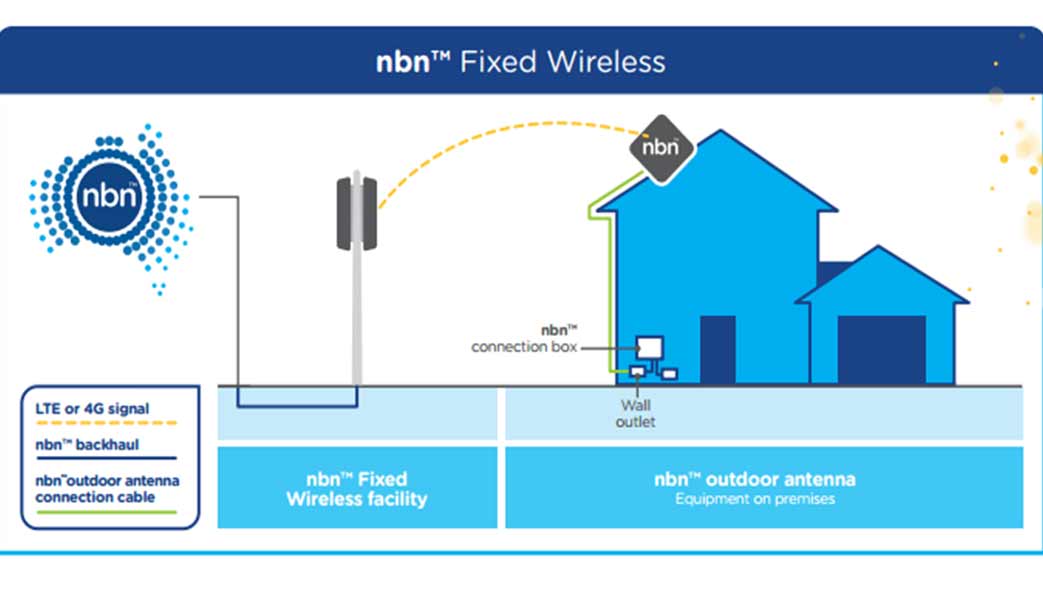
    Fixed Wireless

    NBN 101

    The fixed wireless network will use nbn™ fibre to 2,600 Transmission Towers located around Australia.

    These towers will then transmit broadband services to homes using TD-LTE 4G mobile broadband technology.

    That type of technology is planned to cover around 500,000 premises and will help to deliver fast broadband to some regional areas for the first time ever. NBN is currently trialling the fixed wireless network and has seen trial wholesale speeds of up to 50Mbps/20Mbps.

    Long Term Satellite Service

    For the small percentage of people who are unable to connect to a fixed line or fixed wireless technology, the nbn™ network will make use of two new specially designed satellites.

    These next-generation satellites will cover nearly every corner of Australia, from Christmas Island all the way to Lord Howe and Norfolk islands.

    Interestingly the first satellite launched on 1 October to become available to homes and business progressively from mid-2016. Check out the amazing footage of the satellite launch here.

    The existing interim satellite service has a capacity of 4Gbps. When the two new satellites are in orbit, they will have a combined capacity of 135Gbps.

    This increase in capacity will deliver peak wholesale speeds of up to 25Mbps/5Mbps*. This promises to be one of the best ever consumer broadband delivered to remote Australia and equivalent to speeds that many people in the city enjoy now.

    Regardless of what technology is used to connect you to the nbn™ network, this promises to be a huge step forward for the future of Australia’s broadband network.

    *We’re designing the nbn™ network to provide these speeds to our wholesale customers, telephone and internet service providers.  End-user experience, including the speeds actually achieved over the nbn™ network, depends on the technology over which services are delivered to your premises and some factors outside our control like equipment quality, software, broadband plans and how the end user’s service provider designs its network.

    In conclusion, To know more about the nbn™ network, visit our handy nbn™ 101 guide here.

     Reproduced from www.nbnco.com.au

  • Telstra NBN call forward codes

    Telstra NBN call forward codes vary with the type of service that you have with Telstra,

    The Telstra NBN Call forward codes

    All carriers have different set ups to move your calls where you want.

    The strangest is with Telstra Digital business, a multi- line business service.

    In the past, we could have both a line hunt service where your call goes through from line 1 to 2 etc when the lines are busy and call forwarding to a message service or even a mobile phone.

    Not anymore, you can only choose one or the other to work on your service, or can you?

    I have spent a long time with Telstra NBN service to find a way around the problem because many of my messaging clients need a solution. Others just want to go to a mobile after hours or even to a voice mail service.

    So, what is the solution?

    First up you need to change from line hunt to call forwarding. This can be done by calling Telstra or logging into your dashboard and doing the changes yourself.

    I will make this simple for you if line 1 is busy forward call to line 2  if line 2 is busy to line three and so on through all the lines. Simple line hunt. ( your plan will most likely include free local calls but you may wish to check this).

    The important part is no answer and what we do then.

    Line 1 or your listed access line is the main one. This will be the first line called in busy times and or after hours so we work out what to do with it. On no answer forward to a message service or mobile phone or another phone number anywhere.

    Now do the same with lines 2/3 etc.

    On the last line number in the group, we also forward busy calls to our chosen access as well as no answer calls.

    Now go to Telstra accounting and get Line hunt access fee removed
    because it is not needed any more a saving of near $10 a month.

    Again, Line 1 on busy to line 2, line 2 to line 3 etc
    Line 1-2-3 etc on no answer to your selected location.
    Last line both no answer and busy to a selected location.

    It’s a beautiful thing.

    Authors note; I run a message service for business under the banner Verdi business messaging and use this procedure regularly for our customers. When it is too busy, or out of hours you should consider what to do with your messages. We would love to help

    Peter Hanley

    Telstra NBN call forward codes

  • NBN are you getting what you pay for?

    NBN are you getting what you pay for?


    NBN are you getting what you pay for is a relevant question to be visited by every subscriber.

    NBN are you getting what you pay for?

    I searched the net for the list of complaints today and came across this article by the ACCC

    Now I am a guy whose glass is usually half full because I look on the brighter side of things.
    In fact, in a recent article that dealt with an increasing complaint rate, I found an actual decrease in the rate.

    One thing is fact, the NBN will deliver faster internet but will it be fast enough.

    A large majority of connections have opted for the 25mbps plan so one would believe that this is the Norm.

    The gamers and speed freaks want the highest speed possible and want it at a great price.

    There are other options when you want speed,  the NBN is just one of them, one that has a good price tag.

    Because the original plan for the NBN was downgraded we have to suffer some degradation of service.
    This is particularly so when the fibre stops some distance from your house or business.
    It also still suffers from a distance from the exchange.
    There are lots of factors that come into the problem.
    Unfortunately, many factors remain hidden to the general user.

    One popular idea is that some of the cheap carriers are squeezing their capacity so you don’t get to experience a full speed option.

    When you search your address on the NBN Co website

    It will tell you the method of delivery to your premises, Fibre to the Node is a red flag because the last bit is copper. A full explanation is available at NBN here.

    So what is fast enough?

    NBN are you getting what you pay for?

    The Internet from all suppliers back in the ADSL days was topping at about 12 Mbps but did you actually know anyone that got near to that speed, I certainly did not.

    In most cases for householders and small business, the NBN network will be a dual function one.
    You will have Voice and data on the one network. Each Voice active channel will take up about 110kbps.
    It should also be remembered that Data will compromise voice traffic before it impacts on the download.
    In the ADSL days, the voice traffic was split away from the data so no compromise was noticed.

    If you are a high user of Voice and Data simply have two separate NBN channels so you have the best of both worlds.

    No problems

    The average or general home and small business user will have no complaints with speed, cost or download with a variety of options available.
    NBN and the general market reason that high- speed internet is from 25 Mbps upward so the basic is enough for most of us.

    Those wanting 50 or 100 Mbps are catered for under the NBN and those wanting more can access speed and downloads at a price.

    In conclusion, I believe that for a large majority of users we can get what we pay for.

    We also achieve an advance in technology with more uses and often at a cheaper rate overall.
    feel free to make your comment to build on the discussion.


  • The best internet connection for my business

    The best internet connection for my business

    The best internet connection for my business is discussed in detail and detailing all the necessary decision points.
    Reproduced from an Article by Greg Lipschitz CEO of the Summit Group

    In business these days it’s necessary to have a reliable internet connection. Your business and its internet connection are complementary. The kind of internet connection you need depends on what kind of business you have.

    It goes without saying that if you’re a one man band who does minimal online work a Fibre service of 100Mbps would be overkill. Conversely, running an online film editing company on a 4G service would be equally preposterous.

    SO WHAT IS THE BEST KIND OF INTERNET CONNECTION FOR YOUR BUSINESS?

    ADSL2+ & NBN

    Whilst ADSL & NBN are cost effective it can actually end up costing you a lot more than you bargained for in lost productivity and downtime.

    Both of these services are deemed “consumer” and don’t carry the same level of service assurance that true business Ethernet and fibre services come with.

    What do we mean by service assurance?

    Service Assurance relates to how quickly your service runs, how quickly will the provider respond in the event of a problem, how quickly will a problem be fixed and if you will receive a rebate if your service isn’t running properly or is down.

    Will I get the full speed on ADSL and NBN?

    Both ADSL and NBN are speeds “up to” services. This means that whilst you may order a 25/5Mbps NBN service, it may only perform at 18/3Mbps. Similarly, ADSL theoretical maximum is 24/1Mbps but rarely performs at full speed. This is due to a number of factors, mainly, the underlying technology of the copper network, distance from the exchange or node and network contention ratios.

    If you run a small team or a business where an “always on” internet connection isn’t important, then an ADSL or NBN service may be suitable for your business.

    If the internet is super important to your business operations, a Fibre or Ethernet Internet service is more suitable.

    Ethernet and Fibre Internet

    This is the most common type of connection that we provide at Summit. Fibre and Ethernet internet services scale from small businesses all the way up to large enterprises. If you use cloud services like Office 365 and Google Apps, have multiple offices with a VPN, do a lot of video conferencing, need a dedicated internet service to upload or store files on cloud-based storage services or just need for guaranteed speeds, then Fibre is the service for you.

    Ethernet and Fibre services also have “symmetrical” speeds, meaning they have the same download and upload rates. The other reason businesses choose Ethernet and Fibre services is that they aren’t “best effort.” They’re guaranteed to be stable at the given speed, so if you’re on the 100/100Mbps plan, then that is what you get – 100Mbps download and 100Mbps upload.

    Business Fibre and Ethernet services also carry Business Service Level Agreements which guarantee performance, uptime and fault restoration. In the unlikely event of an issue, you may be eligible for a percentage of your monthly fee as a service level credit.

    Fixed Wireless

    Fixed Wireless is a service which uses microwave point-to-point wireless connections from the supplier tower or base station to your premises. Some businesses, especially in remote areas, cannot always get a dedicated fibre service. In this instance, Fixed Wireless is a good solution because it is also a symmetrical service that allows you be on the same upload and download with no issues. Fixed Wireless is also a good option as a failover service as it can serve as a good backup to keep your business running smoothly if you have complications with your wired service.

    Telstra 4G Mobile Broadband Data

    Telstra 4G Mobile Broadband is great for businesses that are on the go or have staff that need network access when offsite. However, the service transmits through the Telstra 4G mobile towers, so there can be complications when users are not in mobile range. Most connections these days run through 4G technology that sometimes gets even better speeds than fixed services. This type of connection is useful for pop-up shops, very small businesses who need a very small amount of data or as a contingency plan.

    As you can see, there are benefits and drawbacks to each type of data service. If your business doesn’t rely heavily on the internet, a 100Mbps Ethernet connection would be of little use, while a slower connection would be a problem if you do a lot of teleconferencing. Determining why you need your data connection will help steer you in the right direction when it comes time to choose which type to go with.

    To speak with an internet specialist about what solution is right for your business, give our team a call on 1800 116 116 or request a callback below.

  • small business phone systems australia

    WHAT TO LOOK FOR WHEN UPGRADING YOUR PHONE SYSTEM

    by Greg Lipschitz
    on 25 May 2017
    small business phone systems australia

    Business phone systems can be very confusing. There are so many options, acronyms and tech talk out there.

    With more than 15 years in the business phone game, I have come up with a simple plan for business owners to follow when facing this challenge.

    Start off with an outline of the features and capabilities you and your business require. Consult the different teams, departments and job functions and build a prioritised list of system features in categories.

    Act it out.

    “Put yourself in the phone call.” Close your eyes and imagine you are a phone call to your business. Try to define how you would like to be treated.

    • Would you like to speak to a real person or press 1 for Sales, 2 for Accounts etc.?
    • How long are you prepared to wait if nobody is available?
    • Would you like to listen to information about the business or would you prefer some nice music while waiting?
    • If no one is available would you like your voicemail to be emailed?

    Business phone features have changed a lot over the past few years. With the introduction of Cloud Phone Systems, the feature set is huge and can give your business the edge in productivity. Here are some phone solutions that can help streamline your business communication and give your callers a better experience.

    • Work from anywhere, anytime – Enable your staff to work from anywhere with the option of a desk phone or softphone on a PC, Mac, iPhone, iPad or Android device.
    • Call recording – Great for call quality control and compliance for sales and support teams.
    • Multiple Offices, One Phone System – No longer do you need a phone system for each office. A Cloud PBX enables all your sites to be one phone system.

    Determining what you need will make your discussions with business phone system providers faster, more productive and ensure a better outcome for your company.

    small business phone systems Australia a discussion point.

    More on hosting..


  • Downside of NBN telephone hosting

    Downside of NBN telephone hosting

    The Downside of NBN telephone hosting and my experience with faults brings forward some basic issues.

    I have just been on the phone with a well-known Carrier for more than an hour and a half. This to get a simple line hunt changed has driven me to despair.

    That problem comes where the carrier must liaise with Telstra for simple changes to be made.

    I am talking to the Philippines from Australia who is talking to Telstra in Australia over a small complication in a Line hunt problem.

    This communications issue occurs regularly where you can not talk or access directly to a change portfolio.

    Working with Telstra can be just as frustrating as the same situation exists.

    I was recently working with an NBN carrier who had his hosting with another carrier and we had the same issue.
    He talks to his provider, he talks to the hosting platform and back to them in Chinese whispers.
    One small slip creates large errors

    If you have had a telephone issue I am sure you have found the same problem, it is common and frustrating. I understand the industry and I find it hard at times let alone someone that is naive to the whole thing.

    I act for many outlets as a dealer therefor I am entrusted to provide a solution.

    Is there an Answer?

    As the industry has evolved more and more businesses are moving to a hosted phone system. Called one in the cloud.

    Furthermore, I am recommending to my clients that they seriously look at this.

    One word of caution is talk directly to the hosting provider and not through a third party.
    How do you know this? Ask the question up front and listen to the answer.

    That being said with hosted phone systems most changes can be done directly by you or a nominated person that can access and is authorised.

    No, you can’t just add services without them but you can change all the common issues that we have on a daily basis.

    You have no need to call that telephone tech, no need to sit on the phone listening to elevator music whilst you wait for someone to take charge.

    I was talking to a site recently and said to the owner you need to call the carrier to get that fixed.
    I could not do it without the confirmation go around. His answer was, “ I don’t have time for that last time I was on the phone for hours”

    There are many advantages to hosted phone systems and not many downsides and this is just one of them.

    This one issue  I believe is critically important and will save you heaps in call out fees and wasted time you can never retrieve.

    How does it work? You have a web login to your service and then just access the changes you need to make.
    If it is too much, simply outsource that to your agent or dealer trained to make your life easy.

    In conclusion.

    Is this a better way? It certainly beats the hell out of the current system.

    More on Hosted phone systems.

    Peter Hanley
    Downside of NBN telephone hosting

    Downside of NBN telephone hosting